The United Kingdom offers extraordinary fully funded scholarship programmes for African students — from the prestigious Chevening Scholarship covering all costs for a master’s degree to Commonwealth Scholarships providing doctoral funding across dozens of British universities. Here is your complete 2026 guide. The United Kingdom in 2026 remains one of the world’s most powerful and most accessible destinations for African students pursuing fully funded international education. Home to Oxford, Cambridge, Imperial College London, UCL, Edinburgh, and dozens of other globally ranked universities, the UK’s academic landscape combines world-class research infrastructure, internationally recognised degree credentials, and some of the most generous government-funded and university-funded scholarship programmes available anywhere in the world.
For African students from Nigeria, Ghana, South Africa, Kenya, Zimbabwe, Rwanda, Uganda, Tanzania, Ethiopia, Senegal, and across the continent — the UK scholarship landscape in 2026 offers pathways from fully funded master’s degrees to fully funded doctoral programmes, from British government-funded Chevening awards to Commonwealth-funded research scholarships, and from specific university full-funding commitments to prestigious society and foundation awards that cover every conceivable academic discipline.
This guide covers the 12 most important fully funded scholarship opportunities for African students seeking UK university education in 2026 — with detailed coverage of what each scholarship covers, who is eligible, how to apply successfully, and what makes competitive applications stand out.
1. Chevening Scholarship — The British Government’s Flagship Award
Funding: Fully funded — tuition fees in full, monthly living allowance, return flights, UK student visa fees, and arrival and departure allowances
The Chevening Scholarship is the UK government’s global flagship international scholarship programme — funded by the Foreign, Commonwealth and Development Office (FCDO) and UK partner organisations. In 2026, Chevening continues to be the single most prestigious and most comprehensively funded scholarship available to African students seeking UK master’s degree education.
Chevening is not simply a financial award — it is membership in one of the world’s most powerful alumni communities, with over 50,000 Chevening Alumni across more than 160 countries who include current and former government ministers, senior diplomats, CEOs, scientists, journalists, and civil society leaders. The Chevening network is a genuinely useful professional community that continues to provide value throughout the careers of Chevening scholars long after the scholarship year ends.
What it covers:
Full tuition fees — paid directly to your UK university for your one-year master’s degree programme
Monthly living allowance — calculated by the UK government at rates sufficient for comfortable living in your UK university city (London and Edinburgh rates higher than other cities)
Return economy class flights — from your home country to the UK and back
UK student visa application fees — the full cost of your UK student visa application
Arrival allowance — one-off payment to help cover initial settling costs
Thesis grant (for qualifying courses)
Study travel grant for essential programme-related travel
UK alumni events access throughout the scholarship year
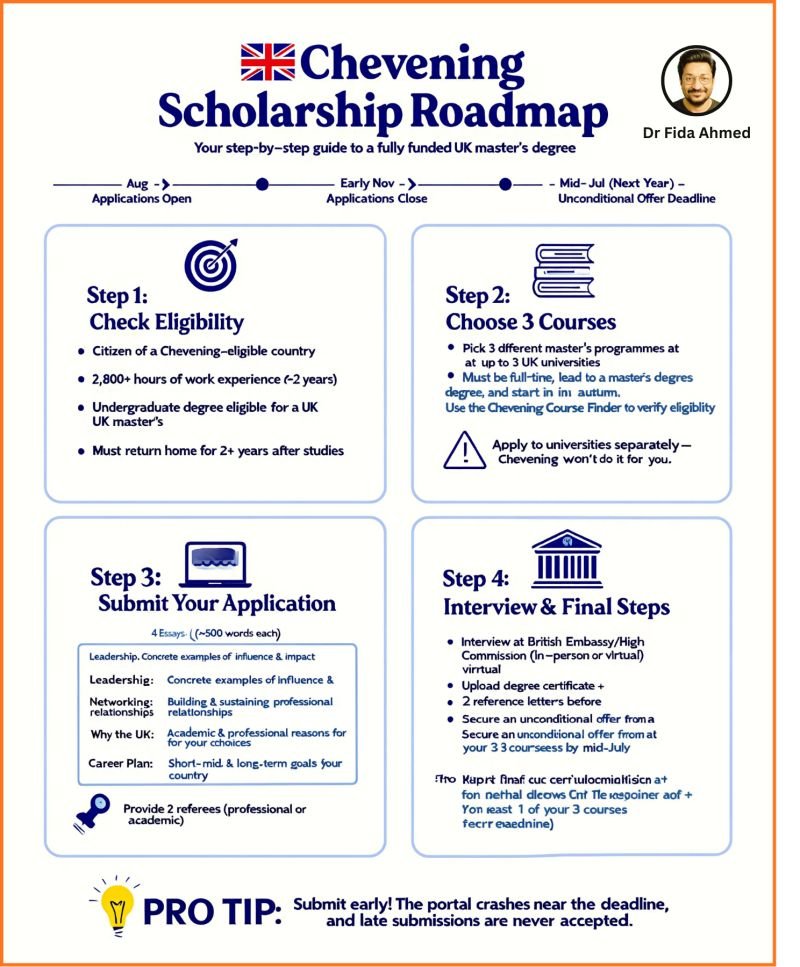
What it funds: One-year master’s degree programmes at any eligible UK university — you choose your university and course, provided it is from the Chevening-approved list (virtually all accredited UK master’s programmes qualify). You may apply to up to three UK universities in your Chevening application.
Eligibility requirements:
Citizen of a Chevening-eligible country — all Sub-Saharan African countries participate; most North African countries also participate. Verify your country’s status at chevening.org.
Have completed an undergraduate degree equivalent to a UK upper second class honours degree (2:1) or above
Have at least two years of work experience (calculated as 2,800 hours of paid work — may include part-time work, internships, volunteering in some circumstances)
Intend to return to your home country for a minimum of two years after completing the scholarship
Not be a permanent resident or citizen of the UK
Apply to three eligible UK master’s programmes (university places confirmed after scholarship award — you do not need a university offer to apply for Chevening)
Leadership requirement: Chevening is explicitly a leadership scholarship — selecting future leaders who will return home and contribute to their countries. Your application should demonstrate documented, specific leadership experience — not just participation in activities, but evidence of leadership impact. Leading a student organisation, founding a community project, managing teams professionally, driving policy change, or creating measurable outcomes in your professional or community life are all compelling leadership evidence.
Application timeline: Applications typically open in August and close in November for the following September academic year. Shortlisted candidates are interviewed by the British Embassy or High Commission in their home country between January and March. Award notifications are issued in June. Apply at chevening.org.
Country-specific advice: Chevening is highly competitive — particularly in Nigeria, Ghana, Kenya, South Africa, and Ethiopia where large numbers of eligible applicants compete for a defined number of country-specific awards. Nigerian and Kenyan applicants in particular should note that competition is severe — exceptional academic records, compelling leadership narratives, and genuine two-year return commitment are essential.
2. Commonwealth Scholarship and Fellowship Plan — For Master’s and Doctoral Study
Funding: Fully funded — tuition, airfare, living allowance, and thesis allowance
The Commonwealth Scholarship and Fellowship Plan (CSFP) is one of the world’s oldest and most respected international scholarship programmes — funding students from Commonwealth member countries to study in other Commonwealth countries. For African students, this means fully funded study opportunities at UK universities funded through the Commonwealth Scholarship Commission (CSC).
Commonwealth Master’s Scholarship: One-year taught master’s degree at a UK university. Covers tuition, flights, living allowance, and additional allowances for approved study-related costs.
Commonwealth PhD Scholarship: Three or four year doctoral study at a UK university. Covers tuition, flights, living allowance, thesis production grant, and study travel grant.
Commonwealth Split-Site Scholarship: Twelve months of doctoral research in the UK while remaining enrolled at your home university doctoral programme.
Eligibility: Commonwealth country citizen; demonstrated academic excellence; studying in a field contributing to development within your home country; typically requires strong recommendation from your home university and endorsement from your home government’s nominating agency.
Nominating agencies in Africa: Each Commonwealth African country has a designated nominating agency — typically the national scholarships board, higher education commission, or ministry of education. Applications are submitted through these national bodies rather than directly to CSC. Contact your national nominating agency for specific deadlines and requirements.
Fields: Commonwealth scholarships specifically prioritise fields with direct development relevance — health, agriculture, engineering, environmental management, education, governance, and economic development are particularly supported.
Application: Through your national nominating agency. Details at cscuk.fcdo.gov.uk.
3. Gates Cambridge Scholarship — For Doctoral and Advanced Degree Study
Funding: Fully funded — all costs for University of Cambridge study including tuition, maintenance, flights, and research support
The Gates Cambridge Scholarship is one of the world’s most prestigious postgraduate scholarships — providing funding for outstanding applicants from outside the UK to pursue postgraduate study at the University of Cambridge. Funded by the Bill and Melinda Gates Foundation, Gates Cambridge selects scholars based on exceptional intellectual ability, leadership potential, and commitment to improving the lives of others.
What it covers: Full University of Cambridge course fees; maintenance allowance at a level sufficient for a single person’s living expenses in Cambridge; return airfare; additional funded allowances for approved expenditures including family allowance and research costs.
Academic standard: Gates Cambridge is one of the world’s most competitive scholarships — the academic bar is genuinely exceptional. Successful applicants typically have outstanding undergraduate records, significant research experience, published work or significant research contributions, and clear and compelling statements of academic purpose connecting their Cambridge research to their broader life goals.
African representation: Gates Cambridge actively seeks diverse scholars from across the world including Africa. African scholars at Cambridge are a valued part of the Gates Cambridge community — the scholarship specifically considers applications in context, meaning strong applications from African universities are evaluated relative to the opportunities available in that context.
Application: Through the University of Cambridge standard graduate admissions process — Gates Cambridge scholarship applications are submitted alongside your Cambridge admissions application. gates.cam.ac.uk.
4. University of Oxford Africa-Specific Scholarships
Funding: Variable — multiple funding streams; several provide full funding
Oxford University offers several fully funded scholarship opportunities specifically for African students:
Oxford Africa Society Scholarship: Partial to full scholarship for African graduate students at Oxford across all departments.
Weidenfeld-Hoffmann Scholarship: Fully funded one-year master’s scholarship for exceptional students from developing countries including Africa who demonstrate commitment to using their education to improve their home countries.
Rhodes Scholarship: The world’s oldest and most famous international scholarship programme — providing fully funded postgraduate study at Oxford University. The Rhodes Scholarship covers all fees plus a maintenance allowance for 2–3 years of Oxford study. African Rhodes Scholarships exist for multiple African countries — Nigeria, Ghana, South Africa, Zimbabwe, East Africa, West Africa, and others. Application through country-specific Rhodes Scholarship Committees. rhodeshouse.ox.ac.uk.
Clarendon Scholarship: Oxford’s flagship scholarship programme for outstanding graduate students. Provides full tuition and a generous annual living allowance for all four years of a DPhil (doctoral) programme or one year of a master’s programme for exceptionally strong applicants across all Oxford departments. Nominated by academic departments based on excellence of graduate application.
Felix Scholarship: Full funding for students from India, Pakistan, Nepal, and Bangladesh — does not cover most African countries directly but is mentioned as a model for how Oxford manages regional scholarships.
5. Edinburgh Global Research Scholarships — Full PhD Funding
Funding: Full tuition fees and a living stipend for the full duration of doctoral study
The University of Edinburgh provides Global Research Scholarships for outstanding international doctoral students in all disciplines — offering full tuition fee coverage plus a stipend equivalent to the UKRI doctoral stipend rate for three years of full-time doctoral research.
Edinburgh’s African Studies programmes, global health research, agricultural science, engineering, and AI and robotics research centres are all particularly relevant for African doctoral students.
Application: Through the University of Edinburgh graduate admissions process — scholarship nominations are made by academic supervisors for the strongest doctoral applicants. eds.ac.uk/studying/graduate.
6. British Council GREAT Scholarship — For African Students
Funding: Minimum £10,000 tuition contribution (partial to full depending on course and university)
The British Council GREAT Scholarship programme, running in partnership with participating UK universities, provides scholarships funded through the UK government’s GREAT Britain campaign specifically for students from participating countries — including Nigeria, Ghana, Kenya, South Africa, Tanzania, and other African nations.
GREAT Scholarships are awarded for one-year master’s degrees at UK universities in fields including science, technology, engineering, entrepreneurship, and sustainability. Some participating universities supplement the British Council contribution with additional institutional funding — creating combined awards that approach full funding.
Application: Through individual participating UK universities — each university manages its own GREAT Scholarship application. britishcouncil.org/great-scholarships.
7. London School of Economics (LSE) Africa Scholarships
Funding: Full tuition and maintenance for qualifying African applicants
The London School of Economics — globally ranked among the world’s top institutions for social sciences, economics, law, and political science — provides scholarship funding for African graduate students through several programmes:
LSE PhD Studentships: Full tuition plus stipend for doctoral research in all LSE departments.
LSE Africa Scholarship Programme: Specific scholarship support for African students enrolled in LSE master’s and doctoral programmes.
LSE-Chevening: Combined scholarship where LSE contributes university-specific funding alongside the UK government Chevening award for selected African Chevening scholars choosing LSE.
Application: Through LSE graduate admissions. lse.ac.uk/study-at-lse/graduate/scholarships.
8. Wellcome Trust Scholarships — Health Research Focus
Funding: Fully funded research scholarships for health-related doctoral and postdoctoral research
The Wellcome Trust — the world’s largest health-focused charitable foundation outside government — funds doctoral and postdoctoral research scholarships at UK universities for exceptional researchers from Africa and other low and middle-income countries pursuing health research.
Wellcome Africa Awards: Specifically designed for African researchers pursuing research careers in Africa — include PhD and postdoctoral support, equipment funding, and institutional development.
Wellcome International Intermediate Fellowships: For postdoctoral researchers from low and middle-income countries wishing to conduct research at UK institutions.
Application: wellcome.org/grant-funding.
9. Nottingham Developing Solutions Scholarships — Africa Priority
Funding: Full tuition and a maintenance grant for one-year master’s degrees
The University of Nottingham’s Developing Solutions Scholarship specifically prioritises applicants from African countries — providing full tuition fee coverage and a maintenance grant for one-year master’s degrees in subjects with direct relevance to international development.
Priority fields: Agriculture, environmental management, engineering, public health, information technology, education, and sustainable development.
The Developing Solutions Scholarship is one of the most specifically Africa-targeted fully funded scholarships at a UK Russell Group university — and one of the most accessible given Nottingham’s commitment to developing country student access.
Application: nottingham.ac.uk/scholarships — Developing Solutions Scholarship.
10. Scotland’s Saltire Scholarship — For African STEM Students
Funding: £8,000 tuition contribution per year of study — partial funding that combines with other sources
Scotland’s Saltire Scholarship is funded by the Scottish Government and provides annual awards for students from Canada, China, India, Japan, Pakistan, and the USA to study in Scotland — but increasingly extends to Commonwealth Africa for specific STEM and health disciplines at Scottish universities (Edinburgh, Glasgow, Strathclyde, Aberdeen, Dundee).
Combined with university merit awards and Chevening, Saltire can contribute to a fully funded package for exceptional African STEM students targeting Scottish universities.
11. Imperial College London PhD Studentships — STEM Doctoral Funding
Funding: Full tuition and UKRI-level stipend for 3.5 years of doctoral research
Imperial College London — ranked among the world’s top 10 universities for science, engineering, medicine, and business — provides PhD studentships for outstanding doctoral applicants in all STEM disciplines. For African engineers, scientists, and health researchers with exceptional academic profiles, Imperial PhD studentships represent one of the UK’s most prestigious fully funded STEM doctorate opportunities.
Application: Through Imperial College London graduate admissions. imperial.ac.uk/study/pg/apply.
12. The Mo Ibrahim Foundation — African Governance Leadership
Funding: Annual salary of $50,000 plus top-up for living costs for a 2-year programme (not a traditional scholarship but a unique leadership development award)
The Mo Ibrahim Foundation’s Ibrahim Leadership Fellowship is not a traditional scholarship — it provides outstanding young African professionals with a two-year placement working directly with the African Union Commission, alongside financial support. Eligible applicants have typically completed advanced degrees and are building leadership careers in African governance, public service, or development.
Application: Mo-Ibrahim.foundation/fellowship.
Making Your UK Scholarship Application Competitive
Step 1 — Take IELTS 7.5 or Above
Chevening requires minimum IELTS 6.5 but competitive applicants score 7.0 – 7.5 across all four skills. Most UK university master’s and doctoral programmes require IELTS 6.5 – 7.0. Invest in IELTS preparation seriously — the score appears on your application and distinguishes competitive candidates. IELTS available across Africa.
Step 2 — Develop a Compelling Return Commitment Narrative
Chevening and Commonwealth Scholarships both require genuine commitment to returning to your home country after study. Your application must convince assessors that you have specific, concrete plans for applying your UK education in your home country — not vague statements about contributing to development, but specific roles, organisations, projects, or policy changes you will pursue upon return.
Step 3 — Document Leadership Impact With Specific Evidence
“I led the university debate club” is not leadership evidence. “I founded and grew the university debate club from 8 to 120 members over three years, trained 40 students in competitive debate, and represented the university at national championships” is leadership evidence. Every leadership claim must be specific, verifiable, and impact-focused.
Step 4 — Identify Your Target University Before Applying
Chevening allows you to specify three universities — research which UK universities are strongest in your field, which have specific Africa research connections, which offer the best scholarship supplementation, and which provide the most relevant career networking for your post-scholarship plans.
Step 5 — Apply Early Within Application Windows
All major UK scholarships receive the largest volume of applications in the final week before deadline — assessors reviewing applications submitted early receive proportionally more attention and less comparison pressure. Aim to submit complete applications 3–4 weeks before the stated deadline.
Conclusion
The United Kingdom in 2026 offers African students an extraordinary array of fully funded scholarship opportunities — from the prestige and comprehensive coverage of the Chevening Scholarship to the doctoral excellence of Gates Cambridge, from the specific Africa focus of Nottingham’s Developing Solutions Scholarship to the STEM doctoral excellence of Imperial College London PhD studentships. The total value of UK scholarship funding available to African students annually represents hundreds of millions of pounds — the vast majority of which is unclaimed because eligible students never apply.
Begin with Chevening — visit your UK Embassy or High Commission website to confirm your country’s application timeline. Prepare for IELTS. Document your leadership narrative. Identify your three target UK universities. And pursue the fully funded UK education that your academic excellence and your community commitment genuinely deserve.